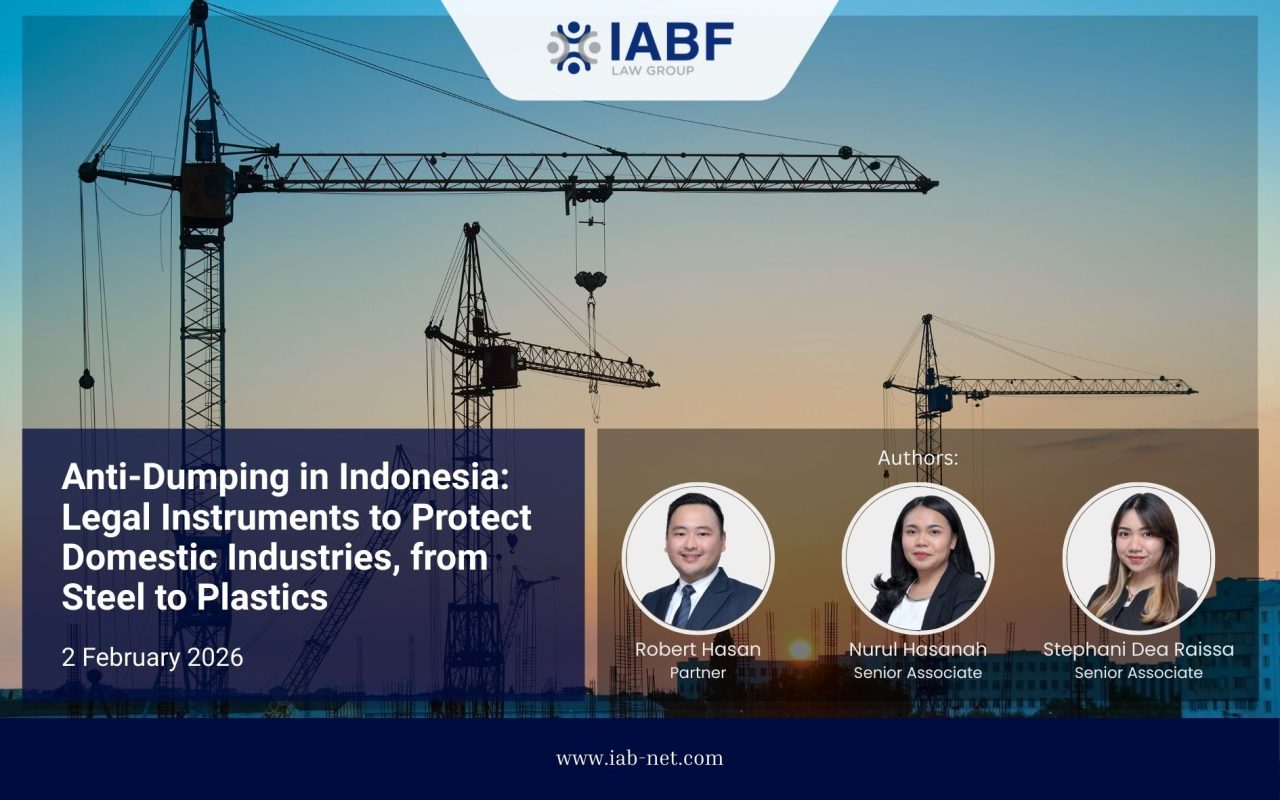
Anti-Dumping in Indonesia: Legal Instruments to Protect Domestic Industries, from Steel to Plastics
In the era of globalisation and free trade, the influx of cheap imported goods is an inevitable phenomenon. In many cases, these low prices are the result of dumping, which is the practice of selling goods abroad at prices below their normal value or production costs.
To protect domestic industries from such unfair trade practices, Indonesia has adopted an anti-dumping regime as part of its commitment to the WTO multilateral trading system. To date, anti-dumping measures in Indonesia have been applied most frequently in the iron and steel sector. However, anti-dumping petitions are now beginning to spread to other industrial sectors, including the plastics industry.
Currently, the Ministry of Trade and the Ministry of Finance are still in the process of inter-ministerial harmonisation to determine the Anti-Dumping Duties (Bea Masuk Anti-Dumping or “BMAD”) on Polypropylene (“PP”) Copolymer from South Korea, Vietnam, the United Arab Emirates, Malaysia, and Singapore. This process began when domestic petrochemical producers filed an anti-dumping petition against imports of PP Copolymer from several countries, and Indonesian Anti-Dumping Committee (Komite Anti Dumping Indonesia or “KADI”) has conducted an investigation into the dumping margin and its impact on the domestic industry. This step marks the expansion of the anti-dumping regime to the petrochemical and plastics sectors as an effort to protect strategic national industries from the pressure of dumping prices.
This article discusses the anti-dumping legal framework in Indonesia, its implementation mechanisms, and actual case examples that demonstrate how these provisions function as instruments for protecting national industries.
The Concept of Dumping and Its Detrimental Effects on Domestic Industry
What is dumping?
Dumping occurs when a product is exported to Indonesia at a selling price lower than the normal selling price in the country of origin.
Dumping is not merely a marketing strategy, it can create distortions in competition because such low prices do not reflect healthy market conditions.
Why is dumping harmful to domestic industries?
Dumping can cause:
a. unreasonable market price reductions, forcing local producers to sell below reasonable levels;
b. loss of market share, as consumers switch to cheaper imported products;
c. declines in production and capacity; and
d. impacts on manpower, including employee reductions and production facility closures.
In the long term, dumping can eliminate domestic producers from the market and create dependence on imports.
Anti-Dumping in Indonesia
Indonesian anti-dumping legislation is regulated in:
- Law No. 7 of 1994 concerning Ratification of the Agreement Establishing the World Trade Organization;
- Agreement on Implementation of Article VI of GATT 1994 (Anti-Dumping Agreement) WTO;
- Government Regulation No. 34 of 2011 concerning Anti-Dumping Measures, Countervailing Measures, and Trade Safeguard Measures (“GR 34/2011”); and
- Implementing regulations from the Ministry of Trade and the Ministry of Finance.
GR 34/2011 defines Anti-Dumping Measures as measures taken by the government in the form of imposing Anti-Dumping Duties on Dumped Goods.
Authorised institutions
Anti-dumping measures are implemented by the following institutions:
- Indonesian Anti-Dumping Committee (KADI): conducts investigations into dumping and industrial losses.
- Ministry of Trade: approves or rejects KADI recommendations and submits KADI recommendations to the Ministry of Finance if approved.
- Ministry of Finance: sets and collects BMAD through Minister of Finance Regulations (PMK).
Mechanism for the Enforcement of BMAD based on Requests
| Stages | Explanation |
| Request |
Domestic industries that have suffered losses submit a request to KADI with preliminary evidence of dumping and losses. |
| Preliminary Evaluation |
KADI assesses the sufficiency of the evidence in the application to determine whether a formal investigation can proceed. |
| Formal Investigation |
KADI collects data from exporters, importers, and local producers to assess the dumping margin and its impact. |
| Provisional BMAD |
If necessary, provisional BMAD may be imposed to prevent further injury during the investigation process. |
| Definitive BMAD |
The Minister of Finance shall impose a definitive BMAD if dumping is proven based on the submission of KADI’s recommendations by the Ministry of Trade. The BMAD must be proportional and not exceed the dumping margin found and shall be valid for a maximum of 5 years. |
| Sunset Review |
After the validity period expires, an evaluation (sunset review) shall be conducted to determine whether the BMAD needs to be extended. |
Examples of Anti-Dumping Cases in Indonesia
- Hot Rolled Plate (HRP) Case
The national steel industry has filed several anti-dumping petitions against imports of Hot Rolled Plate (HRP) from several countries, namely China, Singapore, and Ukraine. The government has imposed BMAD on HRP products based on Minister of Finance Regulation No. 9 of 2025 concerning the Imposition of Anti-Dumping Duties on Imports of Hot Rolled Plate Products from China, Singapore, and Ukraine.
- Cases That Were Not Pursued
Not all anti-dumping petitions result in the imposition of BMAD. In some cases, the government decides not to proceed with KADI’s recommendation, taking into account national supply needs, industrial structure, and broader economic interests.
This shows that Indonesia’s anti-dumping regime is not one of absolute protection, but rather one that considers the balance between industrial protection and market interests.
Conclusion
Anti-dumping is not a protectionist instrument that conflicts with free trade, but rather a legitimate legal mechanism to ensure fair and balanced trade. Through a structured legal framework, objective investigations, and the imposition of proportionate BMAD, Indonesia protects its domestic industry from unfair trade practices while maintaining the integrity of the international trading system.
For business actors, understanding the anti-dumping regime is crucial, not only as a protective tool but also as part of their legal and business strategy in facing global competition. However, the next question is whether the application of BMAD can still protect the industry without creating competition distortions, particularly in sectors that are already dominated by large businesses?
Disclaimer
This article is prepared for general informational purposes only. The content does not constitute legal advice, a legal opinion, or counsel from IABF Law Firm. The information contained herein may not reflect the most current developments. Any quotation, distribution, or use of this information for any purpose is solely at the user’s own risk.
__________________________
Published by: IABF Law Firm
Published on: 02 February 2026