Legal News Update
Contributors: Almaida Askandar, S.H., MBA, Nita Damayanti, S.H., and Clarissa Felicia Hidriani, S.H.
Published on 1 November 2026 by IABF Law Firm, Jakarta, Indonesia.
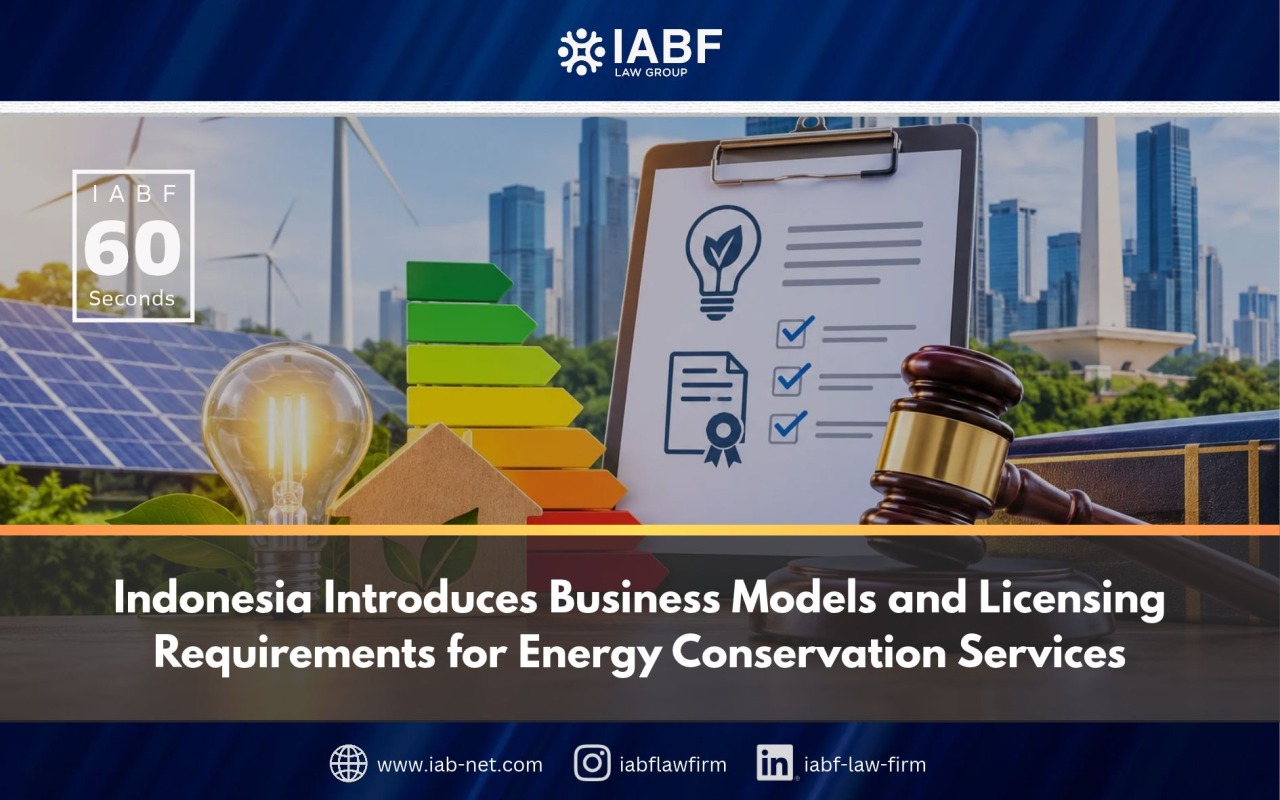
Indonesia Introduces Business Models and Licensing Requirements for Energy Conservation Services
I. Introduction
Indonesia has introduced a more detailed regulatory framework for energy conservation services, including the commercial arrangements available for energy efficiency projects. Minister of Energy and Mineral Resources Regulation No. 1 of 2026 on Energy Conservation Services Business (“MEMR Regulation 1/2026“), which was enacted on 5 January 2026 and came into effect on the date of its promulgation on 8 January 2026, issued to implement Government Regulation No. 33 of 2023 on Energy Conservation (“GR 33/2023“).
In addition, Minister of Energy and Mineral Resources Regulation No. 7 of 2026 on Business Activity Standards for Risk-Based Business Licensing in the Energy and Mineral Resources Sector (“MEMR Regulation 7/2026“), effective from 12 June 2026, sets out the applicable business licensing standards. Together, these regulations govern the scope of energy conservation services, the business models available to service providers and users, and the licensing and reporting obligations of service providers.
II. Scope of Energy Conservation Services
Energy conservation services may be provided by business entities, public service agencies (badan layanan umum) or technical implementation units (unit pelaksana teknis) (“Service Providers“) to energy providers, energy source users and/or energy users (“Service Users“). These services consist of the following activities:
-
- investment-grade energy audits to identify energy efficiency opportunities that are technically and financially feasible;
- financing of energy efficiency projects;
- installation and/or construction work, including monitoring and supervision of energy efficiency projects;
- operation, maintenance and repair of energy installations; and/or
- measurement and verification of energy performance.
These services are directed at energy efficiency projects, namely the implementation of one or more energy efficiency activities in the systems, facilities and processes of the Service Users based on energy-saving performance. An investment-grade energy audit must at least include: (i) the work plan or scope; (ii) the energy baseline before the energy efficiency measures are implemented; (iii) inspection and measurement of energy efficiency; (iv) analysis of energy consumption and costs; and (v) a detailed calculation of the project’s investment requirements, including potential energy cost savings and financial feasibility. Therefore, the project scope and expected performance should be identified before the parties select a business model.
III. Business Models and Contractual Arrangements
MEMR Regulation 1/2026 recognises the following business models for energy efficiency projects. The selected model must be specified in the agreement between the Service Provider and the Service User.
| Business Model | Key Commercial Arrangement |
| Guaranteed Saving | The Service Provider guarantees an agreed level of energy savings over a specified period to recover the Service User’s investment. |
| Shared Saving | The Service Provider and the Service User share the value of energy cost savings at an agreed proportion and for an agreed period to recover the Service Provider’s investment. |
| Build, Operate and Transfer (BOT) | The Service User pays the Service Provider for constructing and operating project assets, which are transferred to the Service User at the end of the payment period. |
| Build, Operate and Own (BOO) | The Service User pays for the construction and operation of project assets by the Service Provider, without the assets being transferred to the Service User. |
| Energy-as-a-Service (EaaS) | The Service User pays for energy-saving services based on the measurement parameters of each type of energy. Examples include cooling, heating, lighting, steam and other energy supply services. |
The regulation also permits other business models based on the parties’ needs. Third parties and/or the financial services industry may support the implementation of these business models, subject to the applicable laws and regulations. Upon completion of the services, Service Providers must deliver the results to the Service Users.
The financing of energy efficiency projects takes the form of an Energy Saving Performance Contract, under which the Service Provider provides goods and/or services for the project and recovers its investment based on an agreed amount determined by the calculated energy savings. Measurement and verification of energy performance is mandatory under this contract. The parties must agree on how the measurement and verification will be carried out. It must be performed either by a Service Provider whose scope covers both project financing and measurement and verification, or by a separate Service Provider for measurement and verification, through a verifier or analyst holding a competency certificate. Service Providers may also be supported by third parties through risk guarantees or other forms of support. Accordingly, the allocation of financing responsibilities, savings risks and measurement arrangements will be particularly important when structuring these projects.
IV. Business Licensing and Reporting Obligations
A. Business Licensing
Service Providers must hold the applicable business licence. Under the current classification in the Online Single Submission (“OSS“) system, energy conservation services fall under KBLI 2025 code 35159 (Other Electricity Supporting Activities), which replaces KBLI 2020 code 35129 as referred to in MEMR Regulation 7/2026. This business activity is classified as medium-low risk and therefore requires a Business Identification Number (Nomor Induk Berusaha or “NIB“) and a Standard Certificate (Sertifikat Standar). Service Providers should confirm that their selected KBLI code and licence scope cover the specific services to be provided.
The main licensing requirements listed in the OSS system include:
-
-
- at least 1 (one) energy conservation expert holding an energy auditor and/or verifier certificate;
- a list of supporting equipment; and
- written statements confirming: (i) consent to a field inspection by the relevant directorate general of the MEMR; (ii) financial capacity to carry out the services; and (iii) commitment to comply with the applicable laws and regulations.
-
B. Ongoing Reporting
MEMR Regulation 1/2026 requires Service Providers to submit the following reports to the Ministry of Energy and Mineral Resources (“MEMR“):
| Report | Submission Requirement |
| Initial report | Within 14 (fourteen) working days after the business licence for energy conservation services is issued, together with a copy of the business licence and the technical documents set out in Appendix I to MEMR Regulation 1/2026. |
| Business expansion report | Within 14 (fourteen) working days after the expansion of energy conservation services is approved, together with a copy of the business licence and the technical documents set out in Appendix II to MEMR Regulation 1/2026. |
| Annual activity report | By 31 December of each year, and at any other time when required, using the format set out in Appendix III to MEMR Regulation 1/2026. |
Reports must be submitted through the MEMR’s electronic information system. Reports may be submitted non-electronically if the system is not yet available or experiences technical difficulties. Failure to submit the initial report, the business expansion report or the annual activity report may result in an administrative sanction in the form of a written warning.
The technical documents vary depending on the activity. In general, they cover: (i) personnel, namely at least 1 (one) certified energy auditor for all activities, at least 1 (one) certified measurement and verification verifier or analyst for measurement and verification services, and at least 1 (one) expert with at least 3 (three) years of experience for financing, installation or maintenance services; and (ii) evidence of the equipment and software used, whether owned, leased or borrowed (not required for financing services). For expansion reports, Service Providers must also attach a list of completed energy efficiency projects and their Service Users. The annual activity report must include a summary of the energy efficiency projects, a calculation of the energy savings and project documentation.
V. Key Takeaways
For businesses considering energy efficiency projects, these regulations provide a framework for choosing a business model and allocating project risks. Prospective Service Providers should assess the applicable licensing scope and the personnel and supporting-document requirements. Both parties should also ensure that the project agreement clearly addresses investment recovery, asset ownership, measurement and verification of energy savings, and reporting responsibilities.
***
Disclaimer
This news update is prepared for general informational purposes only. The content does not constitute legal advice, a legal opinion, or counsel from IABF Law Firm. The information contained herein may not reflect the most current developments. Any quotation, distribution, or use of this information for any purpose is solely at the user’s own risk.