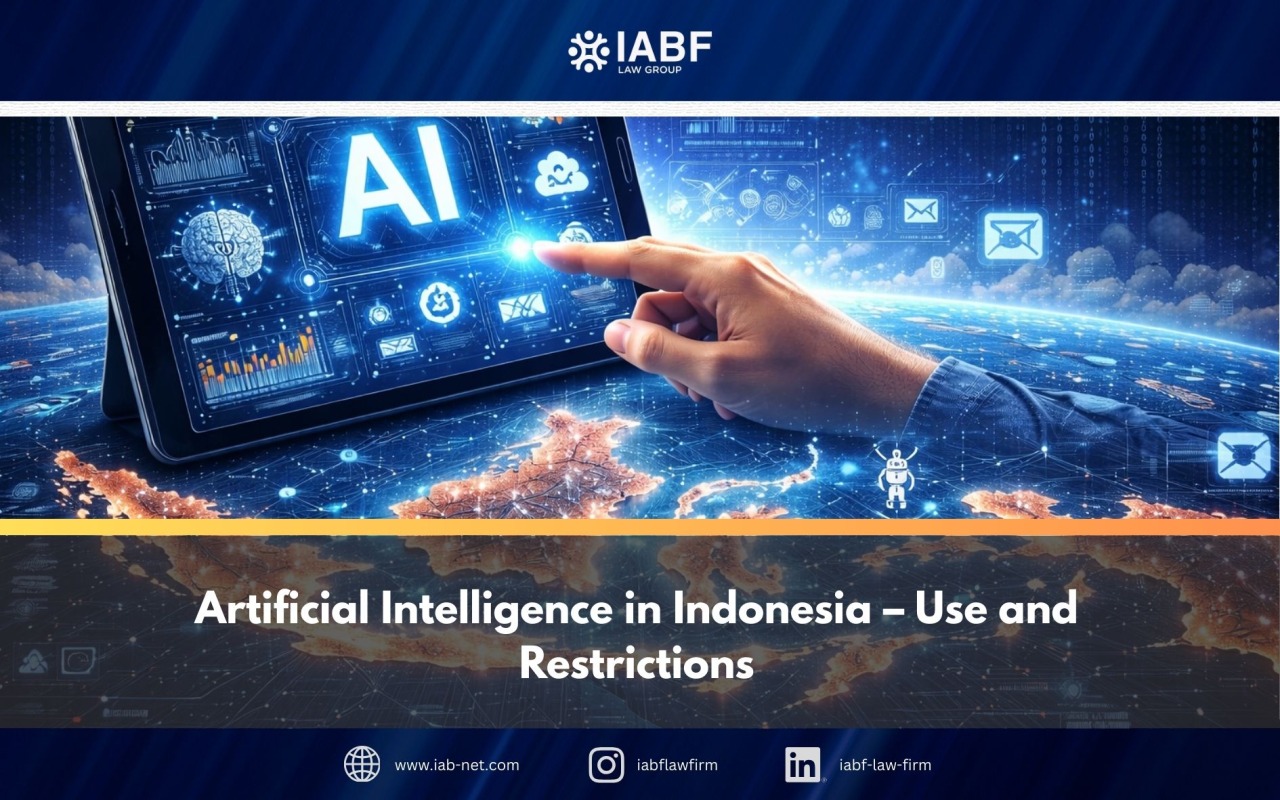
Currently, Indonesia has no law of a statute, which specifically titled with the term of Artificial Intelligence (“AI”). The existence of provisions related to AI are scattered across numerous sectoral regulations in Indonesia. Noticing the growing needs to provide general regulatory provisions in relation to AI, this article will briefly analyze the regulations that specify definition of AI, utilization of AI, and the relevant limitations or restrictions.
I. General Definition of AI
Based on Chapter I (paragraph 1.3-point c) under the Attachment of Presidential Regulation Number 95 of 2018 on the Electronic-Based Government System, AI means artificial intelligence technology in machine that has cognitive functions to learn and solve problems the same way as performed by human. Furthermore, in accordance with Article 5 (a) of Circular Letter of Minister of Communications and Digital Affairs No. 9 of 2023 on Artificial Intelligence Ethics, AI means a form of programming on a computer device to conduct the processing and/or organizing data in an accurate manner.
II. Utilization of AI
A. Standard Business Classification Code or Klasifikasi Baku Lapangan Usaha Indonesia (“KBLI”)
Based on KBLI Year 2020 which is regulated under Regulation of Head of Statistic Central Bureau No. 2 of 2020 on Standard Business Classification Code and the official website of Online Single Submission of Ministry of Investment and Downstream Activity, the programming activity of the basis of AI is classified under KBLI Code 62015. The explanation of such classification covers the activities of consultation that is followed by the analysis and the programming which utilize the technology of AI including a subset of AI such as machine learning, natural language processing, expert system, and another subset of AI.
In line with the above, Minister of Communications and Digital Affairs Regulation No. 15 of 2025 provides that programming activities forming the basis of AI fall under KBLI Code 62015, which carries the same scope of classification activities.
B. Risk-Based Business Licensing
The programming activity on the basis of AI falls into the classification of business licensing for the operational sector of electronic information and transactions (“EIT”) according to Article 186 (1) (d), Paragraph 21 on the operational sector of EIT under Government Regulation Number 28 of 2025 on Risk-Based Business Licensing (“GR 28/2025”). Based on Article 186 (2) of GR 28/2025, Business Licensing to Support Business Activities or Perizinan Berusaha untuk Menunjang Kegiatan Usaha (also known as PB-UMKU) in the operational sector of EIT covers the supporting operations and/or business activity commercial which consist of:
(a) the classification of game product, and
(b) the registration of electronic system operation of the private sector, for the entire business sector.
C. Mandatory Provisions
Minister of Communications and Digital Affairs Regulation No. 15 of 2025 stipulates the mandatory provisions for KBLI 62015 as follows:
(a) Creating and implementing the internal company policies on the internal data and ethics of AI.
(b) Complying with the self-declare for expert worker in accordance with the Standard of Indonesia National Work Competency at least for the Category of Information and Communication of Programming Activity Main Group, Computer Consultation and Other Related Activities in the field of AI Expertise, the sub-field of Data Science.
(c) Publicizing the technological innovation and development to public through event, demonstration, and other methods which can be accessed by public while having the attention to the aspects of privacy and information legality.
(d) Reporting the activities of data security and governance activities to the MCDA annually.
D. The Intersection of AI and the Processing of Personal Data
In condition where the utilization of AI is correlated with the personal data, then Law No. 27 of 2022 on Personal Data Protection (“PDP Law“) is applicable. Article 1 (1) of PDP Law defines Personal Data as data regarding an identified or identifiable individual, either individually or in combination with other information, either directly or indirectly, through electronic or non-electronic systems. Within this framework, AI is not treated as a legal subject under Indonesian law and, as such, cannot assume legal responsibilities under the PDP Law. Nevertheless, any personal data processing carried out through AI is legally ascribed to the party that defines the purpose of the processing and maintains control over it.
Consequently, the party that operates or deploys the AI system is regarded as the Personal Data Controller and bears full legal accountability for compliance with the PDP Law. In this capacity, the Personal Data Controller must safeguard and ensure the security of the Personal Data being processed by: (a) establishing and implementing operational and technical measures to prevent disruptions in processing that violate applicable laws and regulations; and (b) determining an appropriate level of Personal Data security by considering the characteristics and risks inherent in the Personal Data involved in the processing activities.
E. AI Ethics and Responsibility
Referring to Circular Letter of the Minister of Communications and Digital Affairs No. 9 of 2023 on Artificial Intelligence Ethics, several ethical and responsibility guidelines are established in relation to the use of AI. Under the section on Implementation and Responsibility, the implementation of Artificial Intelligence must be carried out on the basis of applicable ethics and codes of conduct governing Business Actors and Electronic System Providers (Penyelenggara Sistem Elektronik/PSE). Furthermore, the operation of AI technology must observe AI ethical values, which include inclusivity, humanity, security, accessibility, transparency, credibility and accountability, personal data protection, sustainable development and environmental considerations, as well as intellectual property.
F. Indonesia’s National Strategy on AI 2020 – 2045 (“National Strategy”)
Indonesia has developed a National Artificial Intelligence Strategy, prepared by a Working Group formed by the Agency for the Assessment and Application of Technology (Badan Pengkajian dan Penerapan Teknologi/BPPT). Although the National Strategy does not constitute a binding regulatory instrument, it outlines priority sectors and key programs for AI implementation, including ethics and policy, talent development, infrastructure and data readiness, research, and industry innovation, as well as sectors such as healthcare, bureaucratic reform, education, food security, and smart cities. One of its key initiatives is the issuance of a Presidential Regulation on AI, intended to create legally binding obligations for stakeholders to achieve the Strategy’s targets. As of October 2025, this regulation has been drafted and completed and is currently being finalized, with one notable provision requiring AI products to bear an AI label.
III. Restriction in Relation to the Utilization of AI
A. AI Must Not Infringe Third-Party Copyright
Under Law No. 28 of 2014 on Copyright (“Copyright Law”), copyright grants exclusive economic rights to the Author or Copyright Holder. Pursuant to Article 9 paragraph (1) of the Copyright Law, such economic rights include, publication of the works; reproduction of the works in all forms; translation of the works; adaptation, arrangement, or transformation of the works; distribution of the works or their copies; performance of the works; communication of the works; and rental of the works. Further, Article 9 paragraph (2) of the Copyright Law stipulates that any person exercising such economic rights must obtain prior authorization from the Author or Copyright Holder. Article 9 paragraph (3) of the Copyright Law expressly prohibits any person, without such authorization, from reproducing and/or commercially using a copyrighted work.
In this context, the utilization of AI systems does not diminish or override the exclusive economic rights granted under Article 9 of the Copyright Law. Where AI systems reproduce, adapt, transform, or otherwise process copyrighted materials, whether as training data or in generating outputs, such acts may fall within the scope of economic rights protected under the Copyright Law. The automated nature of AI processing does not eliminate the legal qualification of such acts as reproduction or transformation of a work. Therefore, the use of AI systems involving copyrighted materials requires prior authorization from the Author or Copyright Holder.
B. The Prohibition in Connection with the Utilization of Personal Data
In condition where the utilization of AI is correlated with Personal Data (as mentioned in Section II.D above), Article 65 of PDP Law states the prohibition provisions in Personal Data utilization as follows:
(a) Every person is prohibited from unlawfully obtaining or collecting Personal Data that does not belong to him/her with the intention of benefiting himself/herself or other, which may cause the loss to the subject of Personal Data.
(b) Every person is prohibited from unlawfully disclosing the Personal Data that does not belong to him/her.
(c) Every person is prohibited from unlawfully using the Personal Data that does not belong to him/her.
Disclaimer
This news update is prepared for general informational purposes only. The content does not constitute legal advice, a legal opinion, or counsel from IABF Law Firm. The information contained herein may not reflect the most current developments. Any quotation, distribution, or use of this information for any purpose is solely at the user’s own risk.
__________________________
Published by: IABF Law Firm
Published on: 12 February 2026