Legal News Update
Contributors: Almaida Askandar, S.H., MBA, Nita Damayanti, S.H., and Renata Luisa Kusuma, S.H.
Published on 26 July 2026 by IABF Law Firm, Jakarta, Indonesia.
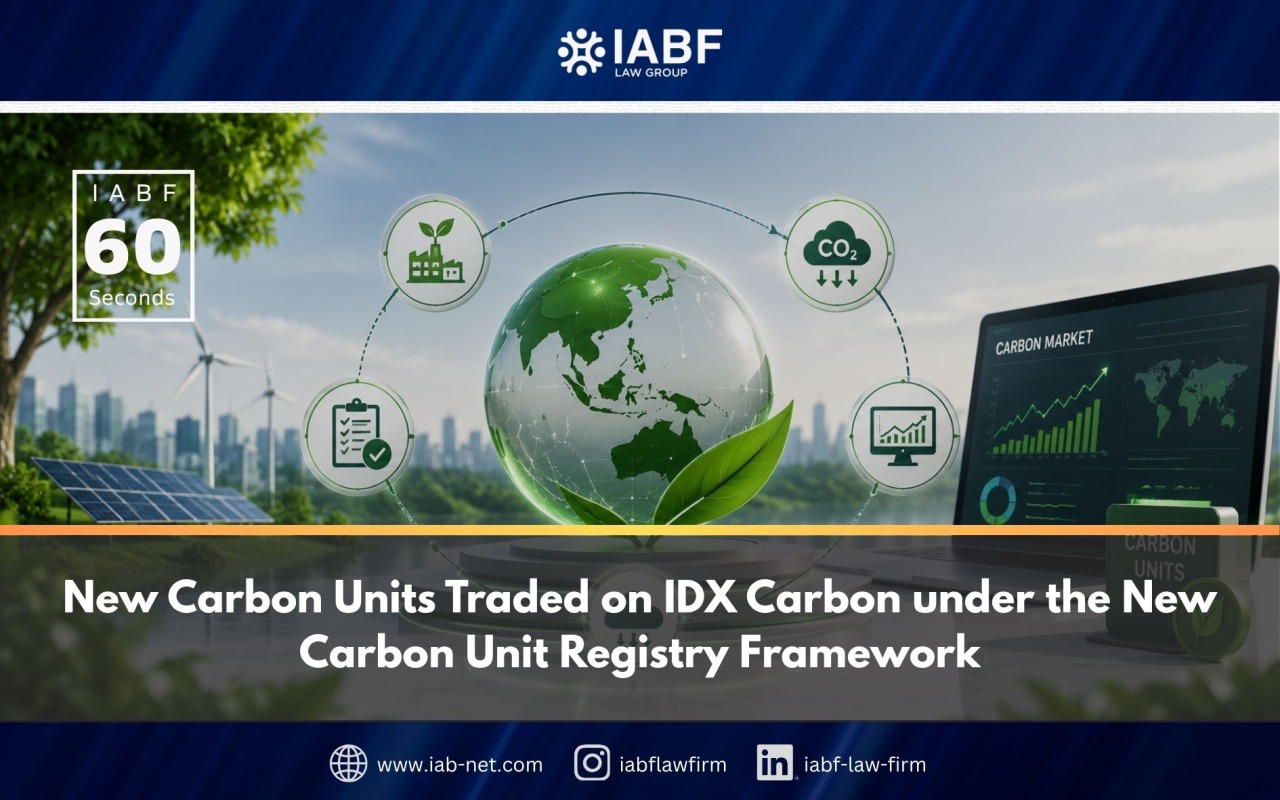
New Carbon Units Traded on IDX Carbon under the New Carbon Unit Registry Framework
I. Introduction
On 2 July 2026, two implementing regulations were issued to align the existing carbon trading framework with the applicability of Presidential Regulation Number 110 of 2025 on The Implementation of Carbon Economic Value Instruments and National Greenhouse Gas Emission Control (“Regulation 110/2025”), namely (i) Financial Services Authority Regulation Number 10 of 2026 on the Amendment of Financial Services Authority Regulation Number 14 of 2023 on Carbon Trading Through IDX Carbon (“FSAR 10/2026”) and (ii) Minister of Environment/Environmental Control Agency Regulation Number 10 of 2026 on the Carbon Unit Registry System (“MER 10/2026”).
These implementing regulations follow the enactment of Regulation 110/2025, which became effective on 10 October 2025 and revoked Presidential Regulation Number 98 of 2021 (“Regulation 98/2021”). Regulation 110/2025 introduced amendments to the framework for recording climate change mitigation actions and carbon units, including two methods for recording carbon trading, namely: (i) carbon trading that must be recorded in the Carbon Unit Registry System (Sistem Registri Unit Karbon, “SRUK”); and (ii) carbon trading that may be recorded on the Indonesia Carbon Exchange (“IDX Carbon”). Further provisions concerning the procedures for recording carbon trading are to be stipulated in implementing regulations, as mandated under Regulation 110/2025.
In this regard, MER 10/2026 provides that the SRUK is connected to information systems for recording carbon units, including the National Registry System for Climate Change Control (Sistem Registri Nasional Pengendalian Perubahan Iklim) and IDX Carbon, based on a cooperation agreement concerning data compliance, data integrity, and data interoperability, using international data model standards.
II. The Key Amendment in FSAR 10/2026
FSAR 10/2026 provides that traded carbon units must be initially recorded in the SRUK and the IDX Carbon. FSAR 10/2026 allows the IDX Carbon to facilitate the trading of carbon units recorded in the electronic system of the relevant ministry at the latest 3 (three) months after 2 July 2026 until the respective SRUK becomes operational. In addition, FSAR 10/2026 permits IDX Carbon to facilitate the trading of foreign carbon units that are not recorded in the SRUK under the following conditions:
-
- The foreign carbon units have been registered, validated, and verified by an institution accredited by the administrator of an international registration system and/or have been recorded on the overseas carbon exchange;
- Other requirements as determined by the FSA following coordination with the Minister of Environment;
- The IDX Carbon must ensure the integrity, quality, and recording standard for the carbon units; and
- The trading of the relevant carbon units is not prohibited under applicable laws and regulations.
| List of Carbon Units: Traded on the IDX Carbon | |
|
Before the enactment of FSAR 10/2026 |
After the enactment of FSAR 10/2026 |
| 1) The Technical Approval of Business Actor’s Emission Threshold or Persetujuan Teknis Batas Atas Emisi Pelaku Usaha (PTBAE-PU)
2) Greenhouse Gas Emission Reduction Certificate or Sertifikat Pengurangan Emisi Gas Rumah Kaca (“SPE GRK”). |
1) The emission quota of GRK
2) SPE GRK 3) Non-SPE GRK
|
III. Relevant Provisions on the IDX Carbon and SRUK in MER 10/2026
Carbon unit transactions are conducted through, among other activities, carbon trading on the IDX Carbon. Carbon unit transactions include: (i) transfers of ownership, (ii) changes in status, and (iii) reductions in the volume of carbon units resulting from the fulfilment of obligations or carbon trading activities by the person responsible for a business and/or activity.
Obligation of IDX Carbon in Relation to SRUK
In summary, MER 10/2026 provides that carbon unit trading transactions on the secondary market shall be conducted through IDX Carbon by way of conducting (i) data interoperability with the SRUK and (ii) recording of the relevant transaction. The SRUK may reject the recording if (i) the received data is inconsistent with the total number of carbon units in the seller’s financial account and/or (ii) there is an indication of money laundering. MER 10/2026 specifies the following obligations:
-
- IDX Carbon must provide a system interface or data communication protocol integrated with the SRUK. Data exchange between IDX Carbon and the SRUK concerning carbon unit quantities must be conducted in real-time; and the SRUK operator shall make adjustments to transaction records, changes in carbon unit status, and any update on the ownership of carbon units.
- Transaction records must contain the information concerning the carbon units including at least the identity of the owner, the number and code, its type and quantity, and the identity of the recipient.
- Adjustment relating to changes in carbon unit status must include the following:
-
-
- Retired: when removed from distribution to be used in the completion of the reduction target of emission GRK, compensation of emission, and/or other purposes in accordance with laws and regulations;
- Suspended: when the action of temporary suspension is imposed toward the use, transfer, trading, and/or recording of carbon units in the SRUK in accordance with laws and regulations;
- Cancelled: when the action of deletion status is imposed toward the carbon unit in the SRUK, so the respective carbon unit cannot be used, transferred, traded or claimed; and
- Available: when the recorded carbon unit in the SRUK does not hold the status of retired, suspended, or cancelled.
-
Prevention of the Occurrence of Double Counting
MER 10/2026 states that the recording of carbon unit transactions is conducted to ensure, inter alia, the prevention of the occurrence of double counting toward the reduction of Emission GRK. Thus, each carbon unit is prohibited from being issued, claimed, and/or used more than once by any party.
|
Prohibition |
Prevention Activities |
| The prohibition against double issuance of carbon units under more than one certification scheme; | Geographic coordinate-based verification system and methodology for calculating reduction and/or removal of emissions of GRK. |
| The prohibition against double claiming:
1) Claiming more than one carbon unit for a climate change mitigation action at the same location and during the same time period; 2) Claiming made by multiple parties; and/or 3) Claiming the same emission reduction achievement made by both the issuing country and the purchasing foreign country or party at the international level. |
The issuance of a carbon unit to 1 (one) party based on a legally valid agreement and the designation of retired status for compliance of obligation.
|
| The prohibition against double use with the aim of: (i) fulfilling emission target obligations or (ii) conducting voluntary claims on a repeated basis or by more than one party. | The authorization and recording of corresponding adjustments which was conducted by the Minister of Environment. |
Sanction
MER 10/2026 stipulates that any person in charge of a business and/or activity who violates the provision in MER 10/2026, imposed with the sanctions in the form of (a) revocation of the issued SPE GRK, (b) permanent closure of the account in the SRUK, (c) an obligation to undertake emission remediation or purchase the carbon unit replacement which equivalent to the total of manipulated unit; and/or (d) administrative sanction which imposed by the Minister of Environment based the respective authority and provisions of laws and regulations.
***
Disclaimer
This news update is prepared for general informational purposes only. The content does not constitute legal advice, a legal opinion, or counsel from IABF Law Firm. The information contained herein may not reflect the most current developments. Any quotation, distribution, or use of this information for any purpose is solely at the user’s own risk.