Legal News Update
Contributors: Almaida Askandar, S.H., MBA, and Tubagus Bambang Chaeruman, S.H.
Published on 10 July 2026 by IABF Law Firm, Jakarta, Indonesia.
Nutrition Labeling on Ready-to-Eat Processed Food Products under Ministry of Health Decision No. HK.01.07/2026
On 14 April 2026, the Ministry of Health of the Republic of Indonesia issued Ministry of Health Decision No. HK.01.07/MENKES/301/2026 (“MoH Dec. No. HK.01.07/2026”). This decision sets out the technical requirements for the inclusion of nutrition labels on ready-to-eat processed food products, as stipulated in Article 37 paragraph (1) jo. Article 38 of Ministry of Health Regulation No. 3 of 2026 concerning Disease Control (“MoH Reg. No. 3/2026”).
The decision forms part of the Ministry of Health’s efforts to address the high prevalence of non-communicable diseases (such as obesity, hypertension, and stroke) linked to excessive consumption of sugar, salt, and fat (“SSF”). It aims to do so by providing the public with clear information and education to support healthier food choices.
Although full implementation of MoH Dec. No. HK.01.07/2026 remains pending the determination of maximum SSF content thresholds, the decision nonetheless provides practical guidance for business actors in the food and beverage industry. This includes the prescribed format and placement of nutrition labels as well as the methodology for calculating SSF levels.
At present, the obligation to include nutrition level labels applies exclusively to large-scale business actors (pelaku usaha skala usaha besar) and to beverage products.
I. Background
MoH Dec. No. HK.01.07/2026 was issued to implement Article 38 paragraph (5) of MoH Reg. No. 3/2026, which provides that the technical requirements for the inclusion of nutrition labels and health messages on the information media of ready-to-eat processed food products shall be determined by the Minister of Health.
The inclusion of nutrition labels and health messages is based on the business actor’s self-declaration of SSF content, supported by test results from government laboratories or other accredited laboratories.
II. Inclusion of Nutrition Labels
MoH Dec. No. HK.01.07/2026 requires nutrition labels to be included on the following types of information media:
-
- menu list;
- retail packaging;
- brochures;
- banners;
- flyers;
- menu list on commercial electronic applications;
- leaflets; and/or
- other forms of information media.
(hereinafter referred to as “Information Media”)
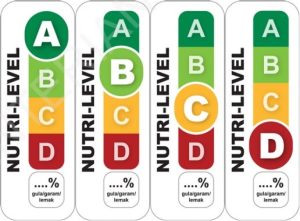
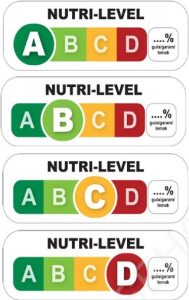
Nutrition labels must conform to the standard format prescribed under MoH Dec. No. HK.01.07/2026, as set out below:
|
Horizontal Format |
Vertical Format |
 |
 |
|
Logo Simplification
|

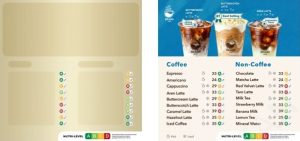
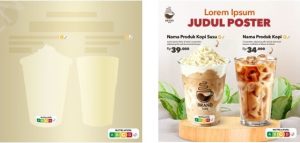
Furthermore, MoH Dec. No. HK.01.07/2026 provides illustrative examples of nutri-level label inclusion on various types of Information Media, as shown below:
|
Inclusion on Menu List |
Inclusion on Retail Packaging |
 |
 |
|
Inclusion on brochures, banners, flyers and leaflets |
|
 |
|
III. Nutri-Level System: A – D Classification
Nutri-level classification is determined as follows:
-
- LEVEL A
Nutri-Level A applies exclusively to beverages that do not contain added sweeteners and meet the following SSF content criteria:
Sugar : <1 g
Salt : < 5 mg
Fat : < 0,7 g
-
- LEVEL B
Nutri-Level B applies exclusively to beverages that contain only natural sweeteners (e.g., Stevia, Honey, Palm Sugar) and meet the following SSF content criteria:
Sugar : <1 – 5 g
Salt : < 5 mg
Fat : < 0,7 g
-
- LEVEL C
Nutri-Level C applies exclusively to beverages that contain a mixture of natural and artificial sweeteners (e.g., Stevia + Sucralose, Palm Sugar + Stevia + Sucralose, Honey + Stevia + Sucralose) and meet the following SSF content criteria:
Sugar : <1 – 5 g
Salt : < 5 mg
Fat : < 0,7 g
-
- LEVEL D
Nutri-Level D applies exclusively to beverages that contain a mixture of natural and artificial sweeteners and meet the following SSF content criteria:
Sugar : >10 g
Salt : > 500 mg
Fat : > 2,8 g
The nutri-level is determined by the nutrient (among sugar, salt, and fat) with the highest content per 100 ml. The displayed nutri-level corresponds to the highest level among the three individual nutrient levels.
The nature of the sweetener serves the primary factor in determining the nutri-level classification. Beverage products that utilize natural sweeteners may achieve a nutri-level B rating, as long as they comply with the relevant nutrition content threshold.
IV. Nutri-Level Value Calculation
While MoH Dec. No. HK.01.07/2026 does not prescribe detailed methods or indicators for calculating salt and fat content — merely providing that salt content shall be determined based on sodium analysis and saturated fat content based on total fat analysis — it sets out a clear methodology for sugar content calculation.
Sugar includes all monosaccharides and disaccharides, excluding lactose. MoH Dec. No. HK.01.07/2026 provides the following formula for calculating sugar content per 100 ml:
Formula: Sugar value per 100 ml = (Total Sugar – Lactose) × (100 ÷ Serving Volume in ml)
The calculated sugar value shall be rounded to one decimal place. For example, a value of 5.01% shall be rounded to 5.0%, and the nutri-level shall be classified based on the rounded figure (e.g., classified as ‘B’).
Simulation:
|
Total Sugar (per serving) |
Total Lactose | Sugar – Lactose | Value per 100 mL | Level |
|
19 g / 250 mL |
4 g / 250 mL |
15 g / 250 mL |
6 g / 100 mL |
C |
|
41 g / 330 mL |
8 g / 330 mL |
33 g / 330 mL |
10 g / 100 mL |
C |
| 20 g / 500 mL | N/A (tidak tercantum) | 20 g / 500 mL | 4 g / 100 mL |
B |
V. Implementation
The obligation to include the nutri-level label shall only become effective two (2) years after the Ministry of Health determines the maximum SSF content thresholds. As of the date of this Decision, the Ministry of Health has not yet stipulated such thresholds.
VI. Sanctions
With reference to Article 89 of MoH Reg. No. 3/2026, any person who violates the provisions on SSF consumption control for ready-to-eat processed food products under Article 37 paragraph (1) of MoH Reg. No. 3/2026 shall be subject to the following sanctions, which shall be imposed progressively:
-
- Written warning;
- Administrative penalty;
- Temporary suspension of production activities and/or product distribution;
- Withdrawal of the processed food product from the market; and/or
- Revocation of the business license.
The above sanctions shall be applied in sequence, except where the violation poses a risk to public health.
***
Disclaimer
This news update is prepared for general informational purposes only. The content does not constitute legal advice, a legal opinion, or counsel from IABF Law Firm. The information contained herein may not reflect the most current developments. Any quotation, distribution, or use of this information for any purpose is solely at the user’s own risk.