Legal News Update
Contributors: Almaida Askandar, S.H., MBA, and Rania Adhara Safira, S.H.
Published on 6 June 2026 by IABF Law Firm, Jakarta, Indonesia.
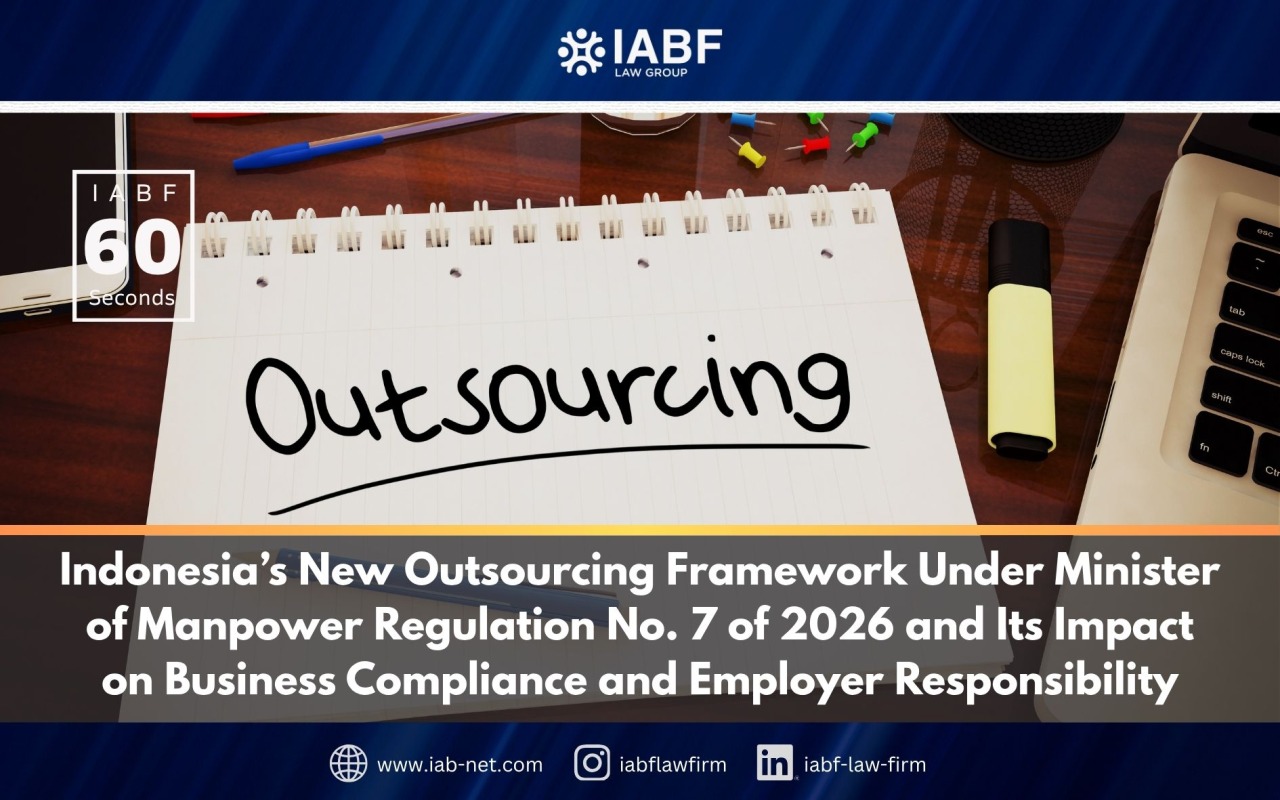
Indonesia’s New Outsourcing Framework Under Minister of Manpower Regulation No. 7 of 2026 and Its Impact on Business Compliance and Employer Responsibility
Indonesia has introduced a new outsourcing framework through Minister of Manpower Regulation No. 7 of 2026 on Outsourcing (“MoM Reg No. 7/2026”), which came into force on 30 April 2026. Although concise, this regulation marks an important change in Indonesia’s labour regulatory landscape, particularly for companies that rely on outsourced manpower. MoM Reg No. 7/2026 was issued as a follow-up to Constitutional Court Decision No. 168/PUU-XXI/2023 and reflects the government’s intention to strengthen worker protection while maintaining business continuity. In practical terms, outsourcing remains permitted in Indonesia, but it is now subject to narrower limitations, clearer documentation requirements, and closer supervision by labour authorities. One of the key changes under MoM Reg No. 7/2026 is the limitation on the types of work that may be outsourced. Outsourcing is now restricted to supporting activities in the form of labour service provision, which include:
1) cleaning services;
2) food and beverage supply services;
3) security services;
4) driver and employee transportation services;
5) operational support services; and
6) supporting work in the mining, oil and gas, and electricity sectors.
MoM Reg No. 7/2026 introduces “operational support services” (layanan penunjang operasional) as one of the permitted outsourcing activities. However, the regulation does not clearly define this term. As a result, it may cover various activities that support a company’s daily operations, subject to further guidance from the government.
In addition to narrowing the scope of permissible outsourcing activities, Regulation 7/2026 also introduces stricter documentation requirements. Every outsourcing arrangement must now be set out in a written outsourcing agreement containing mandatory provisions prescribed by the regulation. These agreements must at least specify the type of outsourced work, the duration of the agreement, the work location, the number of outsourced workers involved, and the respective rights and obligations of the outsourcing company and the user company. More importantly, the agreement must also explicitly regulate worker protection and statutory employment rights. These include wages and overtime pay, working hours and rest periods, annual leave entitlements, occupational safety and health protections, social security participation, religious holiday allowance (THR), and workers’ rights upon termination or expiry of the outsourcing arrangement.
These requirements make outsourcing agreements more than ordinary commercial contracts. They are now important compliance documents that may be reviewed by labour inspectors. Therefore, companies should ensure that their agreements are drafted not only from a commercial perspective, but also from an employment law compliance perspective. Another important change is the increased responsibility of user companies. Under the new regulation, user companies are expressly required to ensure that outsourcing providers comply with statutory labour protections and workers’ rights. This means that companies using outsourced manpower can no longer treat worker protection as solely the responsibility of the outsourcing provider.
MoM Reg No. 7/2026 further requires outsourcing companies to register outsourcing agreements with the local manpower office where the work is performed within 3 (three) working days after the agreement is signed. Registration may be suspended or refused if (i) the outsourced work does not fall within the permitted categories; or (ii) the agreement does not contain the mandatory provisions required under the regulation.
This registration requirement creates an additional compliance checkpoint. Any weakness in work classification or agreement drafting may cause delays and create operational risks. Non-compliance may also lead to administrative sanctions. User companies that violate the permitted scope of outsourcing or fail to comply with the regulation may be subject to:
1) written warnings;
2) restrictions on business activities;
3) limitations on production capacity; and
4) delays in the issuance of business licenses.
These sanctions show that outsourcing compliance is no longer only a documentation issue. It may directly affect business operations, licensing, and continuity. For existing arrangements, MoM Reg No. 7/2026 provides a transition period. Existing outsourcing agreements remain valid until their expiry. However, the types and fields of outsourced work must be adjusted to comply with the new regulation no later than 30 April 2028. Although this gives companies time to adjust, businesses should begin reviewing their outsourcing structures as soon as possible.
Disclaimer
This news update is prepared for general informational purposes only. The content does not constitute legal advice, a legal opinion, or counsel from IABF Law Firm. The information contained herein may not reflect the most current developments. Any quotation, distribution, or use of this information for any purpose is solely at the user’s own risk.